Carbrooke Connection and Art
This page documents the connection between Carbrooke and the Moray-Smith family, focusing on the works of art associated with the village and the church.
Biographical information about the Moray-Smiths already exists elsewhere, and links to selected sources are provided at the bottom of this page. The aim here is to record the relationship between the family and Carbrooke, and to document the works they created or commissioned that remain connected with the village.
Father George
Father George was the Parish Vicar from 1927-1955 and became a close friend of the Moray-Smiths. This friendship brought the couple to Carbrooke regularly, both as guests at the vicarage and through their connections within the village.
The relationship resulted in a number of works associated with Carbrooke, including private commissions for Father George as well as commissions for the church.
Works by John Moray-Smith
Works by Catherine (Katrin) Moray-Smith
In July 2026, while sorting through stored items in the church, Julie Denton, a member of the St Peter & St Paul’s congregation, discovered two dusty, faded prints in black frames.
Closer examination revealed that the prints were rhyme sheets, a popular form of decorative printed verse during the 1930s, created and printed by Catherine (Katrin) Moray-Smith, née Catherine Muriel Mann.
Rhyme sheets were ephemeral items, much like greetings cards. Produced by both amateur and professional artists, they enjoyed a period of considerable popularity but were usually discarded after use. As a result, very few examples have survived.
No other works by Catherine Moray-Smith have been identified in the published literature. The preservation of these two framed rhyme sheets is therefore of particular significance, as they may represent the only known examples of her work.
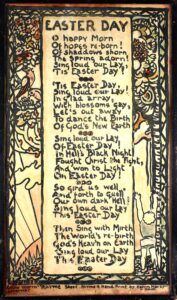
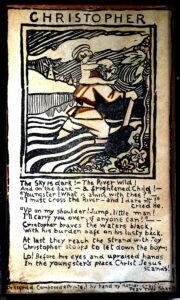
Attribution
The attribution of these prints to Catherine Moray-Smith is based on several pieces of evidence. One of the works bears the name “Katrin Moray-Smith”, while the second contains the inscription “Pear Tree Shanty, East”. Although cryptic, this may be a reference to the Moray-Smiths’ home in the informal “shanty village” settlement at Costessey.
The two prints share a consistent style, format and method of colouring. Their provenance from the church, which had commissioned work from John Moray-Smith, together with the known association of the Moray-Smiths with the Vicar, Father George, provides further support for the attribution.
While no wider catalogue of Catherine Moray-Smith’s work has currently been identified, these examples provide strong evidence that she was responsible for their creation. Further research may reveal whether additional examples of her work survive elsewhere.