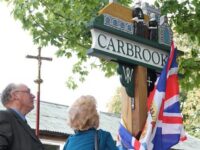
A Medieval “Kidnapping” with a Twist
Looking through the records of 15th-century Norfolk, you will find a story from the summer of 1451 that sounds like the plot for a movie. It involved an armed raid, a high-stakes chase across the county, a local commandery used as a legal shield and ends in a plot twist.
A Raid at Woodrising
The story begins on June 8, 1451, at a manor house in the nearby village of Woodrising. Jane Wichingham (often called Jane Boys in historical records as she was the young widow of Robert Boys) was sitting down to dinner with her mother and grandmother. Suddenly, a gang of up to 60 men armed with swords, bows, and lances, burst into the house.
The leader of the gang was a gentleman named Robert Langstrother. He and his men surrounded Jane and forced her onto a horse, riding away towards Carbrooke before anyone could stop them.
Why Flee to Carbrooke?
Under medieval English law, kidnapping an heiress was a capital felony, meaning Robert could face execution. To escape the immediate pursuit of the Norfolk sheriff, Robert rode straight to the Carbrooke Preceptory.
Carbrooke was run by the Knights Hospitaller, who answered directly to the Prior of the Order in England, the Pope, and the King – not to local law enforcement. Because of their “right of sanctuary,” the local sheriff and his constables were legally barred from crossing the preceptory’s boundaries to arrest anyone.
Even better for Robert, the Preceptor at Carbrooke at the time was William Langstrother, a relative. The walls of Carbrooke provided the perfect refuge, allowing the gang to pause, regroup, and stay out of the reach of the law.
The Plot Twist: A Staged Escape?
This is where the story takes a twist. While the official court documents describe a terrifying, violent kidnapping, the aftermath suggests something very different.
In the 1400s, wealthy fathers strictly controlled who their daughters married in order to secure land and political power. If a young woman fell in love with someone her family disliked, they had no legal way to be together. To bypass this, couples would often stage a “ravishment” – a fake kidnapping.
– In this case Edmund Wichingham had planned for Jane to marry Richard Southwell to consolidate the estates of their Norfolk and Suffolk families.
Just eight days after the raid, Jane and Robert were married at Wiggenhall St Mary in West Norfolk. Under the law of the time, because Jane legally consented to the marriage after the fact, the criminal charges against Robert completely collapsed.
A Happy Ending
While Jane’s father was furious at first and would spend 2 years trying to sue the couple, his anger didn’t last. Within three years, the family was completely reconciled. Jane’s father dropped the lawsuits and even helped Robert and Jane secure her rightful inheritance. The couple remained together for the rest of their lives.
… A final sting in the tale.
Although all ends well for Jane and Robert, that is not quite the end.
Following Jane’s “ravishment,” Edmund arranged for Richard Southwell to marry Jane’s younger sister, Amy (sometimes recorded as Anne)—albeit 15 years later. This union established the Woodrising estate as the center of the Southwell dynasty.
Richard’s grandson, also named Richard, later became a favored courtier and royal administrator under Henry VIII. From this powerful position as Chancellor of the Court of Augmentations, he oversaw the dissolution of the Carbrooke Preceptory in 1541, ultimately taking possession of the estate himself in 1543
” In the 15th century, the cross of the Knights Hospitaller proved stronger than the law of the land. But in the 16th century, the Southwells proved that if you wait long enough, the crown always wins. The family didn’t just get even; they took the whole estate.”
Sources:
Ravishment, Legal Narratives, and Chivalric
Culture in Fifteenth-Century England
Shannon McSheffrey and Julia Pope
Plain English translation.
Brother Southwell, I commend myself to you, certifying to you that on Thursday morning I spoke with my cousin Wychingham in London, where he let me know of your letter sent to Lee. By this, I perceive the steadfast good lordship and ladyship of my lord and my lady in this matter, etc., which gives cause to all their servants to truly trust in them and to do them true service.
I let you know that the said Wychingham, when I departed from him, had knowledge that Jane Boys was supposed to have come to London that night, and he submitted a petition to the lords to have her released and to have his adversaries arrested. And tonight at Norwich, I was told new tidings that on the Thursday after my departure, she was to appear before the lords, and there she spoke untruthfully about herself, as the bearer of this letter shall inform you if you do not already know it. If these tidings are true, I am sorry for her sake, and I also fear that her friends might pursue the lawsuit more faintly—which God forbid!
For her speaking untruthfully about herself can hurt the case of no one but herself; and even though she wants to ruin her own case, it would be a great pity unless the matter were pursued further—not for her sake, but for the honor of the nobles and others who have worked hard on it, and for the punishment of this great, horrible deed. Therefore, I send you various articles enclosed in a letter here which prove that she was ravished against her will, whatever she says now.
These are the proofs that Jane Boys was ravished against her will, and not by her own consent:
- First: At the time of her abduction, when she was set upon her horse, she reviled Lancasterother and called him a knave. She wept and cried out to him piteously, spoke as harshly to him as could come to her mind, and fell down off her horse until she was bound, calling him a false traitor who brought her the rabbits.
- Item: When she was bound, she called upon her mother, who followed her as far as she could on foot. When the said Jane saw her mother could go no further, she cried out to her and said that whatever became of her, she would never be married to that knave, even if she died for it.
- Item: Along the way, at Shraggary’s house in Cockley Cley, at Beachamwell, and in all other places where she could see any people, she cried out against him, let people know whose daughter she was, and how she was ravished against her will, begging the people to follow her and rescue her.
- Item: Lancasterother’s own priest of the Eagle in Lincolnshire, who shrived her (heard her confession), said that she told him in confession she would never be married to him even if she died for it. The same priest said he would not marry them together for a thousand pounds (£1,000).
- Item: She sent various tokens and messages to Southwell via Robert Inglose, which proves well that at that time she did not love Lancasterother.
- Item: A man belonging to the Master of Carbrooke came several times in the week before she was ravished to Wychingham’s house, inquiring of her maid whether her mistress was betrothed to Southwell or not. This proves well that Lancasterother was not sure of her goodwill, nor did he know her mind; for if he had, he would not have needed to send any spies.
Seeing this, I advise you to move my lord and my lady to act in this matter as vigorously as they have done before, for this matter touches them, considering that they have already begun it. Do not doubt that whatever becomes of the woman, well or ill, my lord and my lady shall gain honor from the matter if it is well pursued; you shall also benefit from it, and the opposing party will face great trouble.
Also, it would be necessary to send word to Wychingham to comfort him in his lawsuit, and advise him to review these articles and proofs of the matter that I have sent to you and put them in writing. However, he must not disclose any of these proofs to any living soul until the time comes for the matter to be tried by a jury (inquest) or otherwise settled. Instead, advise him to say to the lords and everyone else… in general terms that whatever Lancasterother or his daughter say now, it shall be well proved she was ravished against her will. Let him request of the lords that his daughter be placed in his custody and kept away from Lancasterother until the matter is duly examined.
I wish this matter better success because my lady spoke so faithfully to me about it, and that moves me to write to you this long, simple letter of my intent.
Whereas you have been informed that six of Osbern Mundeford’s men were supposedly at the said ravishment, I certify to you truly that it was not so. Osbern Mundeford will do everything he possibly can to help punish the perpetrator, and he desires to know the source of that rumor, of which I pray you send me word, and whatever else you wish.
God keep you. Written at Norwich, the Sunday next before the feast of Saint Margaret. (Calculated to be 16th July 1452)